




19.10.2016
CONDUCTOR OF THE YEAR 2017: SUSANNA MÄLKKI
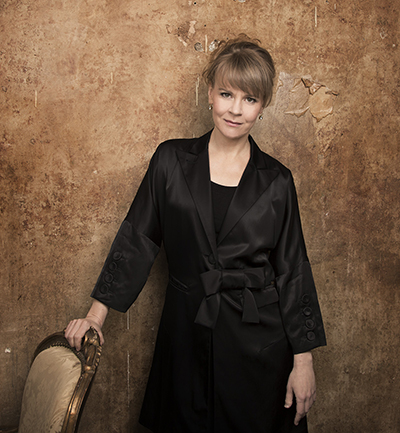
Photo: © 2014 Simon Fowler.
The Finnish maestra
became chief conductor of the Helsinki Philharmonic this season, will
make her Met Opera debut conducting Kaija Saariaho’s L’Amour de loin in December, and led major debuts with U.S. orchestras. She becomes principal guest conductor of the LAPhil next season.
At the Lucerne Festival in late
August 2004, a young conductor, not widely known at the time, made a
packed concert hall sit up by creating thrilling, vital music with the
Ensemble InterContemporain in a program of works by the English
monumental modernist Harrison Birtwistle. Memory stirred. Yes, this was
the very individual who had, two years before, and also at Lucerne, done
the same thing conducting Rimsky-Korsakov’s Scheherazade. That
a musician could be equally adept—and equally remarkable—in new music
and in one of the great but so often under-rehearsed and undervalued
standards was astonishing. This was the kind of artistry that had made
people pay attention to David Robertson a decade or so earlier. Now
there was a new, more exotic name to learn: Susanna Mälkki.
Belonging to the 50 percent of
world-ranking conductors these days who are Finnish, Mälkki studied,
like the rest of that cohort, with Jorma Panula. He was, she says, ”a
very important person in my becoming a conductor,” though the decision
had been made before she joined his class at the Sibelius Academy in
Helsinki. There she also trained as a cellist, and it was with her cello
on the plane or train seat beside her that she began her professional
career, while continuing her conducting studies.
She was, most importantly,
principal cellist of the symphony orchestra in Gothenburg, Sweden,
between 1995 and 1998, when she was in her late twenties. Neeme Järvi
was the music director then, but Gothenburg also attracted outstanding
guest conductors, and Mälkki observed them all. ”It was interesting to
see and hear how the orchestra changed, and how the all-important
interaction worked, the collaboration between conductor and players.”
After Gothenburg, she began
gaining wider experience on the podium, and got her start as a music
director with the orchestra in Stavanger, Norway, in 2002. The
Birtwistle concert in Lucerne, two years later, was her first with the
Ensemble InterContemporain, and led to a position as its music director,
between 2006 and 2013.
It was a role for which she was suited. ”I had already found as a cellist,” she recalls, ”that there was a totally different energy when I was playing new music. I felt more directly in contact with the music and also more liberated, not so bound by what I had been told by my teachers—though Panula, I should add, was so important partly because he encouraged you to find your own way. Also, I think as a musician you may respond more immediately to music composed by someone of your own time, living in the same world as you do.”
It was a role for which she was suited. ”I had already found as a cellist,” she recalls, ”that there was a totally different energy when I was playing new music. I felt more directly in contact with the music and also more liberated, not so bound by what I had been told by my teachers—though Panula, I should add, was so important partly because he encouraged you to find your own way. Also, I think as a musician you may respond more immediately to music composed by someone of your own time, living in the same world as you do.”
However, the hallmark of a Mälkki
performance is the fresh expressiveness she brings to music whether new
or old, as those 2004 Lucerne concerts demonstrated. ”What really
interests me in music,” she says, ”is the subtext, the reason why the
notes are as they are. In the case of new music, there is a reason why
composers do all these crazy things; they mean something, express
something.” Does she, then, feel it useful to explore period techniques
in order to retrieve what music may have meant and expressed in the
past? ”It’s very important to be informed about these things, but what’s
essential is not to force the music in any particular direction, to let
the music have its own flow.”
Since the beginning of this
season she has been chief conductor of the Helsinki Philharmonic, her
first such position with a major orchestra. There she has the chance to
build programs that reflect her taste and experience, most often
including at least one piece from the last 50 years or so in each
concert. Her season opener had newish works by two leading Finnish
composers of today, Kaija Saariaho and Magnus Lindberg, in a
triple-decker sandwich with Ligeti, Sibelius, and Ravel.
Certainly her most daring combination this season, however, is that of Messiaen’s monumental Et exspecto resurrectionem mortuorum with the Rachmaninoff Third Piano Concerto. ”Well,” she insists, ”I
love both these works, and I think you could justify putting them
together as opposites: the spirit and then the senses. Or yes, you could
turn it around and see them as the grieving earth and then heaven. What
matters is that you treat both scores with the utmost seriousness. The
Rachmaninoff, which can suffer so much from tasteless performances, is
highly refined, very classy music.”
Other concerts in Helsinki this
season have her conducting two symphonies by Mahler, a composer for whom
she has been waiting: ”I wanted to develop my tools.” Something else
she has been developing her tools for is more operatic repertoire.
Anything in particular? ”Tristan.”
She will make her Met debut (December 1) in Saariaho’s opera L’Amour de loin,
and is becoming increasingly a presence on this side of the Atlantic.
Her New York Philharmonic debut in May 2015, in a typical program of
Brahms plus Jonathan Harvey (his meditative Tranquil Abiding),
had her being mooted as a possible successor to Alan Gilbert, though
perhaps a top post in this country is something for which, again, she
wants to wait a little longer. And no doubt Helsinki will enable her to
develop more tools for the challenge.
”I love working in the U.S.
because the orchestras are so fantastic, and I feel I can come very
close to my musical goals,” she says. From next season, she will be
principal guest conductor of the Los Angeles Philharmonic, with which
she has worked occasionally since 2010. She has also established
relationships in Chicago and San Francisco.
Someday it will happen. Some
organization looking for a superb musician—one who knows the orchestra
inside out, has great rapport with players, and, besides being able to
make inspiring choices from the contemporary repertoire, can revivify
the classics with her energy and immediacy—will know where to look. Oh,
and she’s a woman. •
Paul Griffiths was born in
Wales in 1947 and worked for 30 years as a music critic in London and
New York. He is known particularly as a writer on new and recent music,
his Modern Music and After, now in its third edition, being the standard work on music since 1945.